A big dog doesn't just grow up with your child… he stands between them and the world. That is a powerful place to be in for a dog. But as quoted in Spiderman, with great power comes great responsibility.
It's a common assumption that smaller dogs would make perfect companions for kids. But in reality, some of the gentlest, most patient dogs on earth happen to be enormous! Choosing a big dog for a small kid requires some planning, research, and temperament testing. Let's get into the nitty-gritty.
Key Takeaways
No dog is automatically great with kids. Even the most naturally gentle breeds need early socialization and consistent training to truly thrive around children.
The traits that matter most in a family dog aren't size or looks — it's patience, tolerance, and the ability to hold it together when a toddler is involved.
The best large family dogs are people-oriented to their core. They don't just tolerate your family, they want to be embedded in it.
Raising a dog and a child together is a two-way relationship. The dog needs to learn to respect the child, and the child needs to learn to respect the dog.
Bite inhibition is one of the most important things you can teach a large dog early. It largely determines how your dog communicates boundaries with your child.
The goal isn't just a dog that tolerates kids. It's an unbreakable bond that shapes both of them for life.
What Makes a Large Dog Good With Kids?
Let's get one thing straight — no dog is automatically amazing with kids. Yes, some dogs are born with a natural maternal/paternal instinct towards tiny living beings. But this instinct also needs to be honed and channeled; else, it could very well become a behavioral issue.
The key traits that make a large dog safe and ideal around small kids are:
High tolerance
Patience
Low reactivity
Affectionate but not overbearing
Ability to control energy
Ability to handle unpredictable movements from kids
Trainability
Basically, they have to be a delightful combination of a chaos gremlin (the kid) and a chaos curator (the dog).
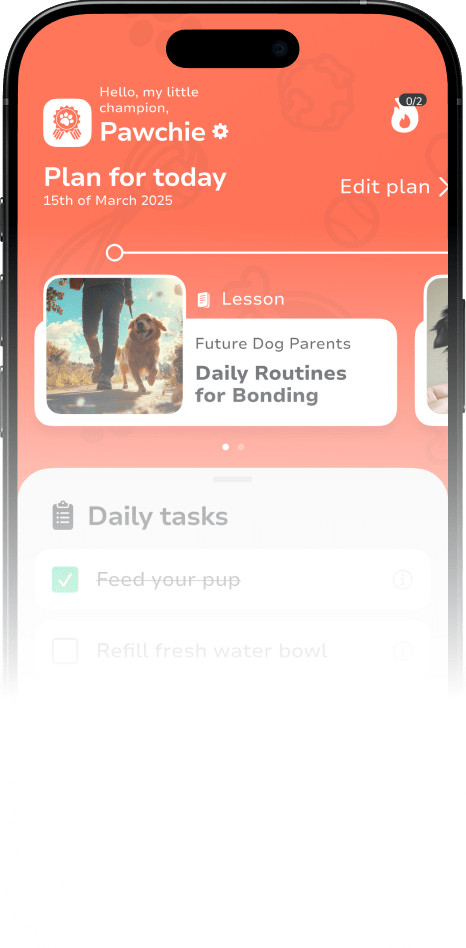
Every large dog has the potential to be great with kids — but potential needs direction. PawChamp gives you a daily training plan built around your dog's temperament, so you're not leaving that potential to chance.
These are the Large and Giant Dog breeds that are affectionate and people-oriented. They don’t just want to be near you; they want to be on you. They thrive on engaging with humans big and tiny. When handled right, you end up with one of the most rewarding relationships of your life, hopefully without getting body-slammed in the process.
1. Golden Retriever: The One Everyone Calls First
When trained and socialized appropriately from an early age, Golden Retrievers are pros at handling toddler chaos without losing their mind. Their eagerness to please and bond with humans makes training them a delightful experience.
Blessed with one of the highest EQs in the dog world, they will catch on if your toddler is in distress way before you.
They are also remarkably patient — the kind of patient that holds up even when a toddler sits on them or pulls their ears with full conviction. And unlike many breeds that simply tolerate children, Goldens genuinely seem to enjoy the chaos.
2. Labrador Retriever: Energetic, Loving, Resilient
Labs are the Humpty Dumpty of dogs! Built for rough and tumble, even the most chaotic kids don't easily rattle them. They are one of the most versatile breeds to have ever walked the planet. They fit right in to a single-residence household, a big family with 8 kids, a special needs family or an outdoorsy family.
While their emotional and physical steadiness is something to rave about, they come with needs that absolutely must be fulfilled. They are a high-energy working breed that needs multiple hours of stimulation every day. Without it, they will get into destructive behaviors, which will be difficult to manage with kids around.
3. Bernese Mountain Dog: Calm, Fluffy, Devoted
These moderate-energy dogs are gentle, deeply devoted, and tend to be natural nurturers. If a Bernese Mountain Dog sees your toddler trying to climb down from the couch, they will make it a point to supervise so that he doesn't hurt himself.
Their size can be imposing, but their demeanour naturally invites kids. The only thing they may need help with is managing their size around the house. They can be quite clumsy, which means they may end up knocking vases over while they walk.
Side note: Their lifespan is shorter than most large breeds, which is something families should know going in… and love them harder for.
4. Irish Wolfhound: The Tall, Scruffy Bestie
One of the tallest breeds in the world, blessed with one of the gentlest temperaments. They are naturally calm and quiet, but also quite resilient. A little bit of boisterous play does not rattle them.
The sheer size of an Irish Wolfhound is a natural deterrent. So you can rest assured that your kid will be threat-free in their presence.
A positive and loving approach is best to manage their rapid growth and sensitive nature. They need to be trained from an early age so that they grow into confident, loving dogs.
5. Saint Bernard: Gentle Giant in Every Sense
Born to rescue stranded travellers in the Swiss Alps, patience and gentleness are literally in their DNA. They are unbelievably calm and impossible to fluster — traits that make them the most deserving candidate around unpredictable small humans.
They are happy to go on long walks and occasional hikes with you while spending a large amount of their time chilling indoors, watching your kid color. They respond well to positive reinforcement training and grow up to be confident, well-rounded dogs if trained from puppyhood.
You'd have to be mindful of two things, though — their accidental tail wag knocking over your toddler, and their drool falling over your baby's head.
6. Newfoundland: The Nanny Dog
Did you know, the Newfoundlands were not originally bred to be family dogs? They were working dogs in harsh conditions — pulling nets, hauling loads, and even performing water rescues.
This kind of work demands personality traits like steadiness, high tolerance, and the ability to think without panicking. A family dog carrying these traits means a dog that is an angel around kids.
Fun fact
They also have a naturally protective instinct and tend to position themselves between their family and anything unfamiliar.
How to Set Any Large Dog Up for Success With Kids?
When raising a kid and a large dog together, you're not just providing both of them with a playmate, but also fostering an unbreakable bond for life. This is a serious responsibility. Keep these pointers in mind to help set everyone up for success:
Socialization — early and consistently. Controlled and consensual exposure to kids, noise, unpredictability.
Train the dog and educate the kids. It should always be a two-way relationship.
No dog should be left unsupervised with very young children regardless of breed or temperament.
Teach children to read dog body language and respect boundaries.
Teach your dog to respect your kid's boundaries.
Teach bite inhibition to your dog from a very young age. Bite inhibition largely decides how your dog corrects your child.
Always provide each of them a safe space to go where the other cannot follow them.
The bond between a child and a well-raised large dog is one of the most special things a family can experience — and it starts with getting the fundamentals right.
How PawChamp Helps?
Raising a large dog alongside kids isn't just about love — it's about structure, consistency, and knowing what to do when things get tricky. PawChamp gives you the tools to build that foundation with confidence.
Here's what you get:
Step-by-step training exercises tailored to large breeds — covering everything from impulse control to bite inhibition and calm greetings around children.
Progress tracking so you can see what's working and where to focus next.
Ask a Dog Expert chat available whenever you're unsure whether a behavior is normal — or needs a different approach entirely.
With the right guidance, raising a large dog and a child together becomes less overwhelming and a lot more rewarding.